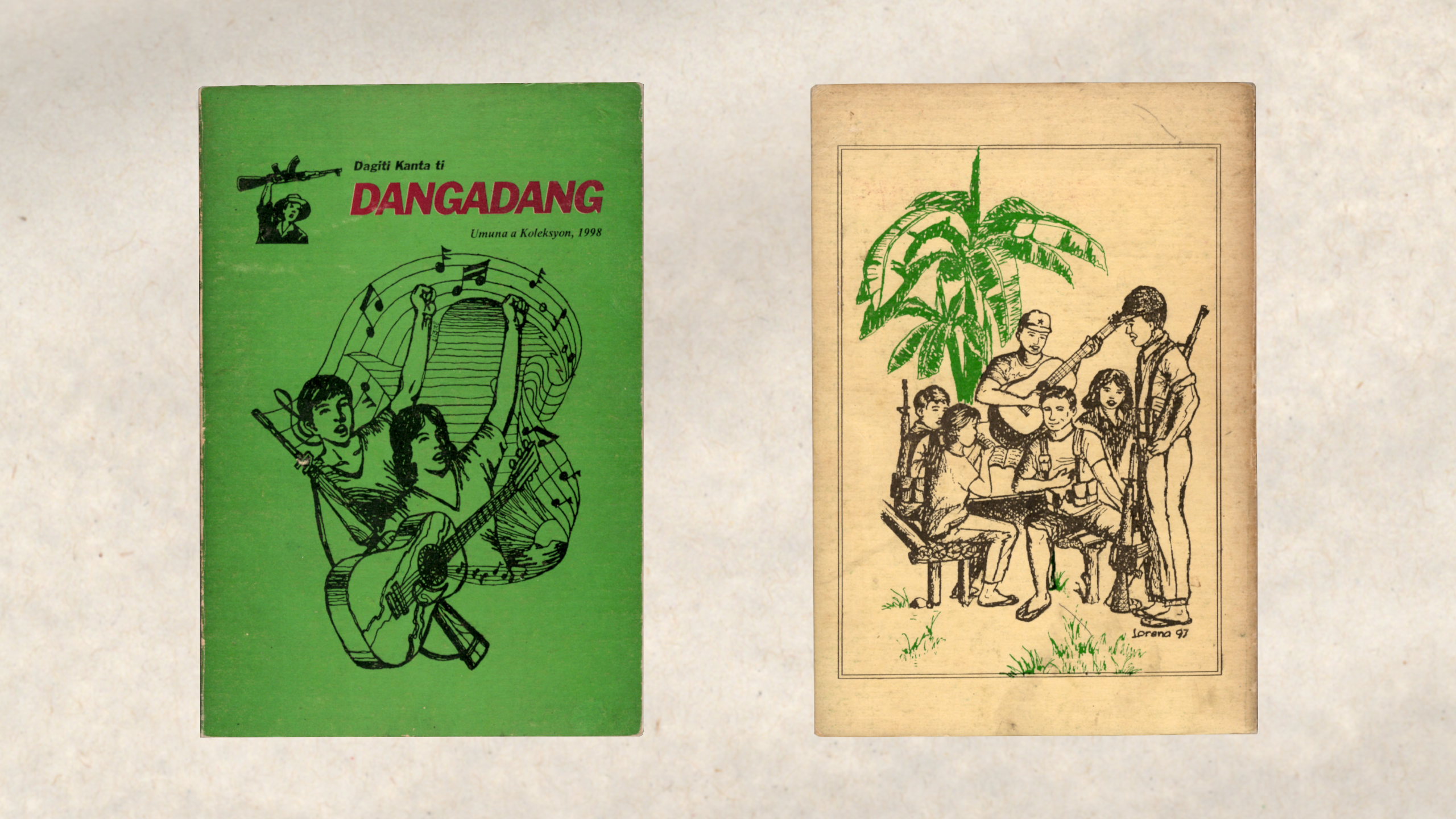
Curator’s Note
For the 59th Carnegie International, Dang A Dang Radio has been commissioned to produce five radio episodes, which will be broadcast on the museum’s website from September through the end of the International.
Each episode emerges from a live event held off-site in the Philippines and co-organized by like-minded organizations and collaborators. Between episodes, the collective will broadcast field recordings from protest assemblies collected through various open calls, capturing what the collective describes as the “sonic political ambience of our time.”
Sound Assembly
Sound Assembly is a collection of field recordings that signify the sonic political ambience of our time, and capture specific moments of protest unfolding in public– such as mobilizations, public speeches, street performances, and other real-time happenings– in capsules of sonic memory. Inspired by street photography or videography, the project aims to document moments that can be re-listened to, providing listeners the perspective of shared active listening.
Listening to field recordings engages the listener’s imagination and allows them to position themselves in that sonic memory in time, as well as associate the sound with their own interpretations. For example, listening to a recording of a protest action wherein the listener was not present allows them to be immersed in that moment, and actively locate themselves in that memory through related information and sonic context clues. Shared listening then becomes an act of collective reflection, combining various political sounds that makes processing memories somewhat more tangible.
Open Call
We invite sound artists, enthusiasts, and listeners alike to submit field recordings, poetry readings, chants, public speeches, street performances, educational discussions, memes, documentation of mobilizations, soundbites, and any audio material that signifies the people’s resistance. We are accepting submissions that respond to the questions:
- How do you define sounds of protest? What is political sound?
- How do we build collective noise / sound / voice that liberates?
Let’s build an audio library that captures the sonic political ambience of our time. These recordings will be reviewed and broadcast online on Dang A Dang Radio. This ongoing archive will be made available for artists to use, sample, or remix to create sound compositions.
For this open call, we’ll be exploring the following themes:
Prompt #1: Land & Self-Determination
Land is life. It’s a mantra that farmers and land defenders always say. A sentence that holds a primordial truth which is increasingly forgotten or trampled upon. It’s not a motto to contend with, but a fact nobody can escape from, not even the most comfortable, most wealthy class.
Despite this truth, widespread landlessness still persists. Seven out of ten farmers in the Philippines do not own the land they till. Almost a million jobs in agriculture have been lost under the Marcos Jr. administration, not only because of the worsening climate crisis, but also because of neo-liberal political traditions that prioritize profit over people, the government’s relentless negligence in providing enough aid, subsidy, and infrastructure to farmers and ordinary citizens, as well as ongoing state militarization in the countryside.
Farmers and activists who fight back against feudalism are met with red-tagging and violence, such as the case of Toboso 19– unarmed civilians and peasant advocates who were killed by the Armed Forces of the Philippines in Negros Occidental on April 19, 2026. The incident is one among many in a decades-long pattern of extrajudicial murders perpetuated by the state, and exacerbated by the Anti-Terror Law and former president Rodrigo Duterte’s “war on drugs.”
Land oppression continues to intensify not just in agricultural-industrial lands, but also in ancestral domains. Companies operating on land controlled by the comprador bourgeoisie continue to build mining sites and green energy projects that over-extract natural resources and exploit human labor. These destructive projects continue to expand in scale and numbers despite indigenous communities fighting for their right to Free, Prior, and Informed Consent (FPIC) and self-determination.
These communities, who have the deepest relationship with the land, know best that land is life. They know best that it is on land where we not only cultivate our food, but also develop social systems and collective mechanisms that allow us to reach self-subsistence as a people. This is why taking back land from those who grabbed it for greed and power means reclaiming not only our sustainable food systems, but also our culture and values that the land itself has been witness to for thousands of generations. Land holds our wisdom, and we should always learn from it. To achieve food security and justice for the future, we must always defend land from those who abuse it.
Prompt #2: Government Accountability
Power tends to corrupt and absolute power corrupts absolutely.” —Lord John Dalberg-Acton, 1887
To say that the Philippine government has reached a state of absolute corruption is an absolute understatement. The state as a criminal entity and leading tax extortion operation is a decades-long undertaking, brought upon by the tyrannic legacy of former president Ferdinand Marcos Sr. (1911–1989), who declared martial law in the Philippines on September 21, 1972. Since then, the dictator and his cronies elevated bureaucrat capitalism to an unprecedented level, systematizing and traditionalizing corruption for the next administrations to come.
Ever since that dark period of history for Filipinos, the people’s movement for democracy has never stopped demanding justice for the hundreds of thousands of people tortured, killed, illegally detained, and forcibly disappeared under state control and violence. Now, 54 years since the Proclamation No. 1081 that placed the country under martial law, the dictator’s son Ferdinand Romualdez Marcos Jr. is President of the Philippines, and the people continue to demand accountability from the government. Today, large-scale corruption takes the form of flood control projects being used as multibillion-peso laundering schemes by lawmakers, or in the unexplained wealth of vice president and former Department of Education secretary Sara Duterte, who is currently on impeachment trial for the misuse of public confidential and intelligence funds totaling 612 million pesos ($9.8 million US dollars).
Since 2025, the Department of Public Works and Highways (DPWH) came under public scrutiny for money laundering in the form of budget anomalies, substandard builds, and ghost projects under infrastructure designed not only for flood control, but also for schools, bridges, and farm-to-market roads. Finally, citizens had more concrete answers as to why public projects took so long to finish and why taxes and prices of goods were rising but wages and infrastructure quality remained low.
The hundreds of plunder cases, complaints, and investigations headed by the Office of the Ombudsman have led to the recent arrest and detention of several prominent personalities in office, such as former House Speaker Martin Romualdez, Senator Jinggoy Estrada, former Senator Bong Revilla, Senator Rodante Marcoleta, and former DPWH secretary Manny Bonoan, who was later released as a state witness. Contractors Curlee and Sarah Discaya, who were both complicit in numerous anomalous flood control projects, were also detained. Zaldy Co, former chairman of the House Committee on Appropriations and owner of several major construction firms that are top contractors of the DPWH, faces malversation and graft cases but is still on the loose as a fugitive. Senator Ronald “Bato” dela Rosa has also been issued an arrest warrant by the International Criminal Court over crimes against humanity linked to former president Rodrigo Duterte’s “war on drugs.” However, dela Rosa evaded arrest in a scandalous incident where the senator was caught on CCTV cameras running from NBI agents in the Senate building. Another tactic to delay detention was made by aforementioned former House Speaker Romualdez, who was confined in a hospital an hour before a warrant was issued against him for non-bailable plunder charges. Romualdez is a cousin of President Marcos.
In his 2026 State of the Nation Address, Marcos claimed, “I am not the president of my family. […] I am the president of the Philippines and my duty is to you, my fellow Filipinos.” Critics of the current regime slam the hypocrisy of the government and the president who belongs to a lineage of political dynasties and benefited from his father’s own history of public works kickbacks. Despite his minimal efforts to quell corruption through the flood control website “Sumbong sa Pangulo” (translated from Tagalog as “Report to the President”), Marcos’s mother, former first lady Imelda Marcos (b. 1929) has never spent a day in jail despite being convicted on seven counts of graft. The Supreme Court has recently overturned her conviction in a ruling that cited the prosecution’s failure to prove her guilt beyond reasonable doubt, despite the Filipino people witnessing the Marcos family’s accumulation of vast ill-gotten wealth during the dictatorship and their wielding of power from the presidential Malacañang Palace for more than two decades.
With justice becoming ever so elusive and the dark past looming over and refusing to leave, what does genuine government accountability look like? Filipinos should never forget the atrocities of martial law, the People Power Revolution that came after, and the continuing struggle of the national movement for democracy so we may remember that the state should not be feared, corrupt, and negligent. We call on people to remember that power in the hands of the few can be abolished by the power of the many.
Prompt #3: Climate Justice
More details coming soon.
Prompt #4: Palestine
More details coming soon.
Let these themes guide you in submitting your field recordings. Find more information on the submission form online.