Seeking to investigate another mode of being with the ground and the proposition of a shared practice of groundedness distinct from the inherited historical, architectural, and choreographic infrastructures of that which has become symbolized as the presence, resonance, purpose, and function of ground—as in the first steps of the projects labeled modernity on fallow land,1 the insatiable potential for geospatial development and industrialization,2 and the development stages for a body to be anatomically organized toward the demands of uprightness3—I want to trouble the proposed omniscience of the upright, rational human as the one who stands over the ground, which always includes the other in its wake. It is an orientation wherein teleologies of progress and their Judeo-Christian ecclesiastical superiority4 suspend the upright human over that which they perceive as beneath them, physically and ontologically.
To make trouble of the ninety-degree orientation5 and its fixation over the ground and those who are grounded down is to create an oblique call for awareness of the minor epistemologies, cosmologies, frameworks, revolutions, and choreographies that are essential counterprinciples of sustenance animating the day-to-day oblique capacities of more life6 on otherwise terms. In this way, that which is lateralized might be deemed self-governable through strategies like standing alongside, or with, or in lineage, or entangled amongst, or in communion with the real and spectral7 formations of being in ensemble with, all the while safeguarding itself from the hostile outside and contradictory terrains of our demanded vertical participation.
I hold these utterances from the minor, hesitant8 sociogenies9 as a kind of insurgent10 Black sociality in my mind when I review the images of African American and African diasporic workers11 tasked to perform hazardous labor through contingent employment under organizational states of suspension at declining industrial yards with unfettered working conditions and negligible wages. And yet, in these images from national sites across the final periods of deindustrializing cities like Pittsburgh, Gary, and Detroit, there are registers of intimacy in the qualities of these Black workers’ shared touch12 in moments of mentorship and tutelage captured in their gaze and proximity. I want to think about the kinds of filial, erotic, conscious, and subconscious kinship13 that are enabled through Black labor, to which I see dance and performance as a constituent act.14 In this way, Black intramural performance cannot be captured entirely by the conditions of material ledgers of without-ness and the prevailing systems of surveillance15 because it is in the performing together that another vantage emerges that does not fit into the narrative formations of liberal progress; something else becomes certain, which I am naming insurgent Black sociality.
The allegorical lesson of this kind of insurgent Black sociality, and the particular kind of Black sociality that demands the participation of the ensemble in task-based performance, always occurs within a contradictory bind of surveillance, illustrating how the longue durée of the body made commodity-form tarries the proletariat impulse of work as being,16 ushering forth a structural impasse wherein the thriving of the Black life-form17 demands wholly restructuring the conditions of equitable labor for the proletariat White worker. In other words, Black insurgent sociality demands that the conditions of the party line and the notion of labor be restructured on its grounds, particularly in its most infrastructural claims of personhood as labor-power.
In the archival documents of those Black workers called to break the White union strike18 lies a necessary story about the role and utility of Black labor as it functions in the origin and entropy of industrial turns that come to mark watershed moments of American modernity. Dance, though readily undertheorized as an extension of industrialized labor, has a similar teleology—for less utilitarian aims, of course, yet highly situated within a libidinal economy of worker oversight, whether it be from the Middle Passage practices of caloric management through the practices of Dancing the Slaves19 or the current-day practice of quelling civilian unrest in response to police brutality through inner-city programs like line dancing at Karaoke with the Cops.20 Within the framework of Black work and/or Black dance, the ninety-degree orientation continues to haunt these Black performances with an imposition to disarm new horizons for the Black worker. But what kinds of cultural cleavages, interiorities, retentions, and intramural kinships does insurgent Black sociality enact on capital?21 How does Black performance as labor restructure the hostile outside with its capacity to reconsider the existential purpose and place of work? How do the choreographies of labor, such as grasping, holding, weight-bearing, and prolonged contact, describe an interstitial Black space of connections that exceeds descriptions of labor-power and object-making?22
Reaching for the minor field of relations between these quotidian practices of production, and disavowing the predominant orientation that work functions as self-making, these hesitant choreographies on the lateral plane reveal a method of performance where the individual is always more than one,23 more than an individuated form. In this tentacular terrain, where collective dispersal rather than propertied accrual governs, there is an essential method moving toward more life, toward a dialogue with the regenerative capacities of the ground24 and the kindness of conviviality.25 These attributes are superfluous to industrial capital’s desire for monocropping and monocultural curation.
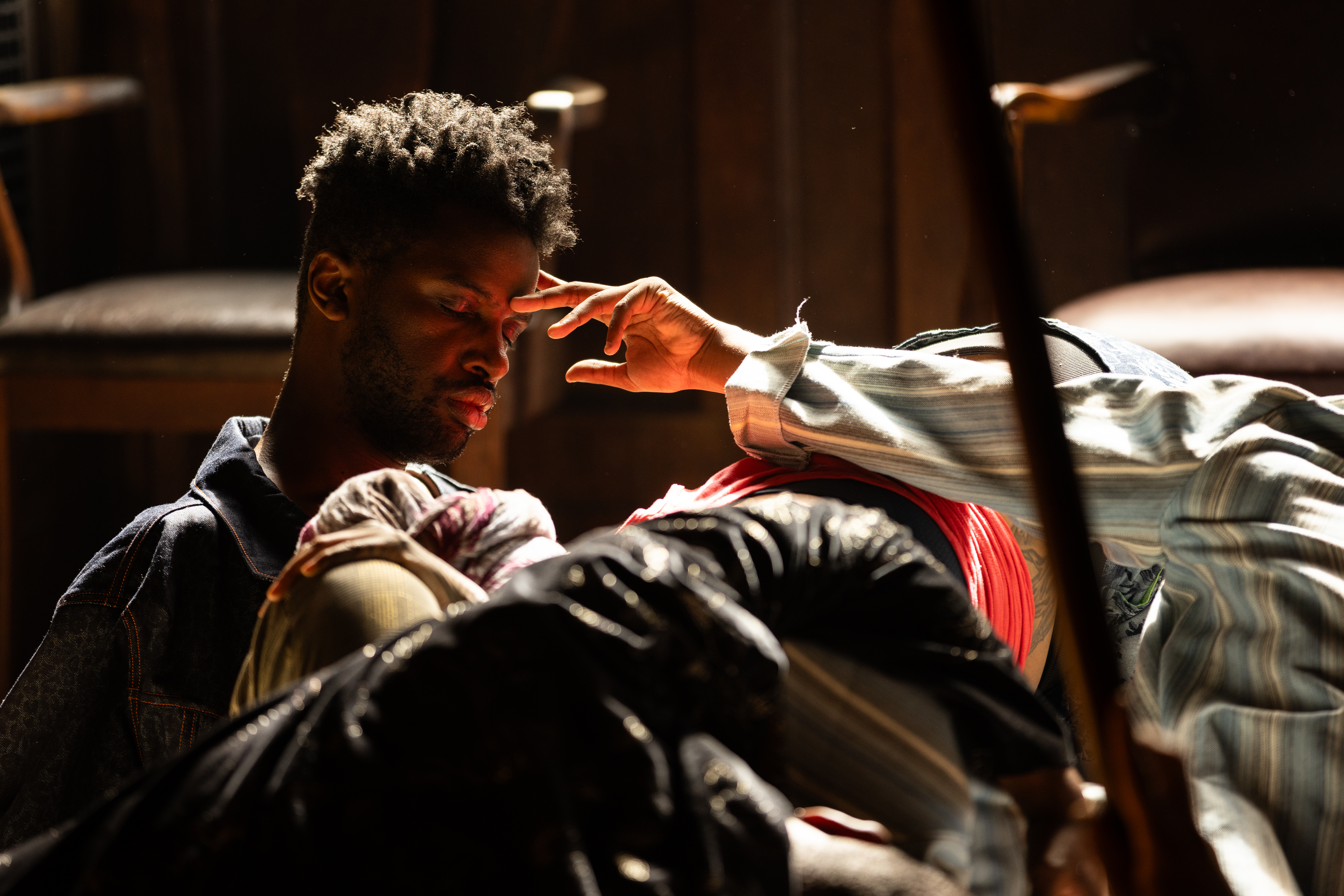
Through this performative practice, whereby an ensemble performs within the container of a museum, an embodied attempt to be in the stakes of laterality, the group gives attention to low altitudes and to the personal, collective, and site-specific crisis these choreographies usher in, with crisis referring to the Greek origins krisis, for turning point. Attenuating toward the sociolinguistics of laterality and away from the logisticality26 of the vertical demands a neurocognitive dis/reorientation to each other and the surroundings as collaborators, all the while demobilizing the tyranny of the vertical and its biocentric order of carceral rationality.
The choreographic and dramaturgical prompt of this work of becoming ground operates as a noun and a verb, where what is to be done serves as a highly structured improvisational practice for a group of performers to do and feel through the frame of a durational27 performance—an elongated and discrete period—and within the spatial bounds of each other and nineteen steps, a stairwell’s landing, a second-floor vista, and a procession off-stage.28 To travel these variable heights while also being available to the psychological dimensions catalyzed by the tactility of skin to skin, skin to stone, skin to stone to air to sweat, and the internal psychoanalytic scripts of new and reenacted rehearsals of laboring, as in performing, together within the suspended temporality of liveness, and to the availing exposure of museum visitors in this place that is not a stage, but a passageway, a between place for travel—that is the task.
In the frame of the physical materiality and metaphysical life of the ground and the practice of shared grounding in the constant teeter of life and death that is dancing, the surface tension of a variety of multicolored marble stones, witnesses, and fellow performers all become systems of support and feedback, so much so that any shift upward is always also occurring in counterpoint to a field of directions, intentions, and relationalities moving, perhaps quantumly, which is to say arising and decaying, referential to a clinamen,29 in myriad seen and unseen planes, emanating from those very real connections that can only emerge by committing to being close with the ground.
Jonathan González (born 1991, Queens, NY; lives in New York, NY) is an interdisciplinary artist whose work spans choreography, sound, image, writing, video, and collective practice. Their artistic research engages themes of memory, Black geographies, and African diasporic temporalities, often through site-specific and durational performance. By combining movement, sound, and image, González creates works that explore embodiment as both a record of history and a rehearsal for the future. González has presented work nationally at major institutions, including Spectral Dances (American Academy of Arts and Letters, 2024), a durational performance and sonic installation, and perejil (Crystal Bridges Museum of Art/The Momentary, 2022), a performance and video work presented in the exhibition Entre/Between. Their writing practice extends their choreographic and visual investigations, and their forthcoming book Ways to Move: Black Insurgent Grammars will be published by Ugly Duckling Presse in 2025. They are the recipient of significant awards, including the Herb Alpert Award in the Arts (Dance, 2024), the MAP Fund (2024), and the Foundation for Contemporary Arts Grants to Artists (Performance Art/Theater, 2019). González’s practice foregrounds hybridity and collaboration, positioning collective action as both an artistic method and a social intervention.