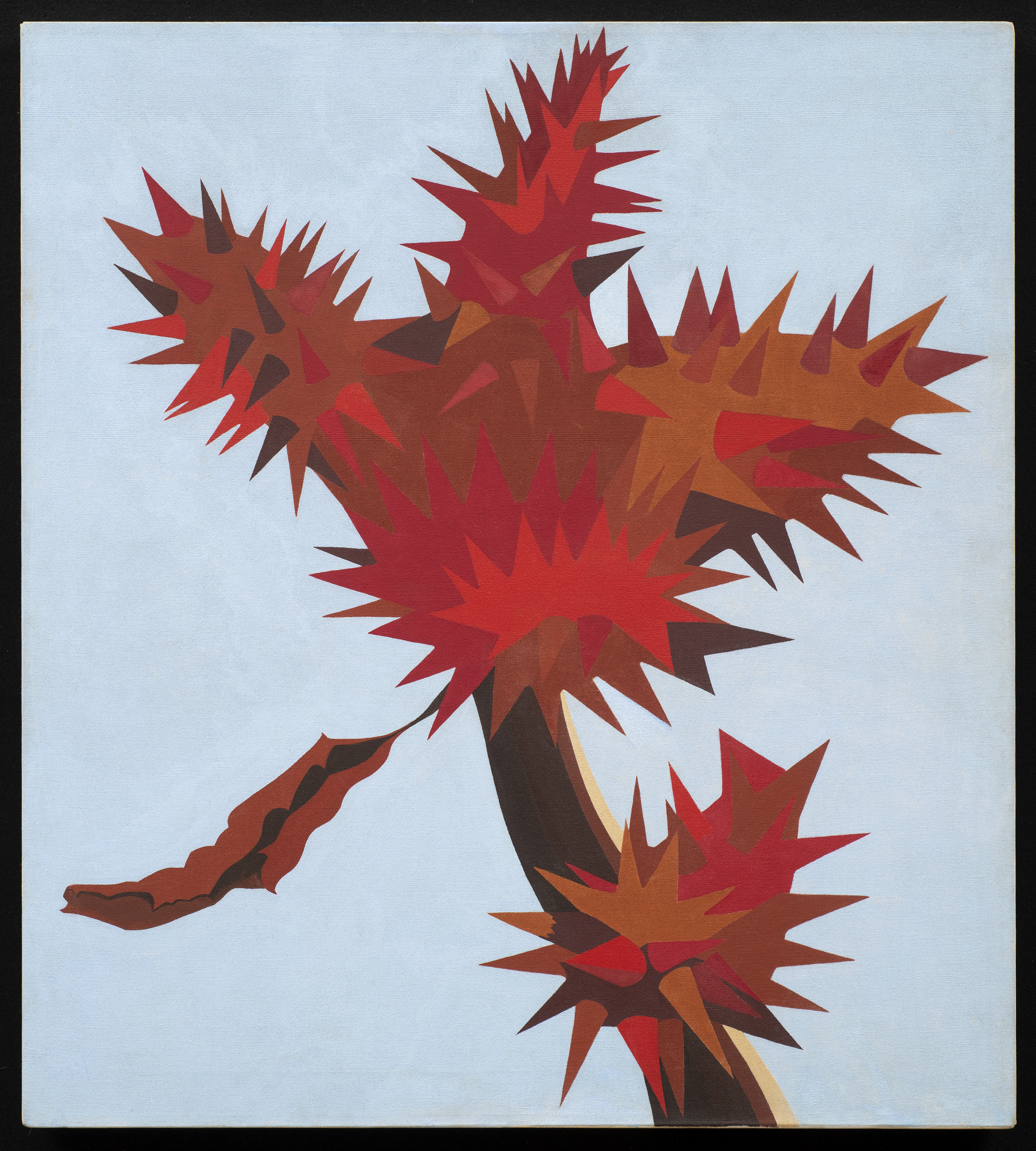
Jay Carrier (Onondaga and Tuscarora from the Grand River Reserve, Ontario, Canada, Wolf Clan, born 1963, Six Nations reservation in Ontario, Canada; died 2025, Niagara Falls, NY) was a lifelong resident of Niagara Falls, New York, and a union employee of Union Carbide. When Jay died in September of 2025 at age sixty-one, I had begun curating his art for an exhibition at 47 Canal Gallery in New York City. The shock of his sudden passing has been present in my plans for the Carnegie International. I want to honor this creative soul. Hubert Jay Carrier studied at the Institute of American Indian Arts in Santa Fe. After graduating, he was recruited by the University of Illinois in Springfield to do graduate work in studio arts. Jay was primarily a painter, but he collected found objects and used recycled materials in his artwork. He was after the essence of our human understanding and sought to convey the primordial mystery present in the simplest of everyday events. Jay’s mother imbued him with a deep understanding of Haudenosaunee cultural teachings. They participated in a ceremonial way of life on the Grand River Reserve. His grandfather Enos was a lacrosse stick maker, and Jay spent his childhood with him and learning from him. His simple message to Jay was to be a good human being.
Katsitsionni Fox (Mohawk, Bear Clan, born 1968, Sudbury, Ontario, Canada; lives in Akwesasne, Mohawk Territory, NY) is an educator, award-winning artist, and filmmaker whose work is deeply rooted in Haudenosaunee culture and the lived experiences of her community. Fox earned an associate degree in fine arts from the Institute of American Indian Arts, Santa Fe (1989), a BA in studio arts from SUNY Potsdam (1995), and an MFA in visual art from Vermont College at Norwich University (2000). For more than twenty years, her work has been exhibited across Turtle Island. Her pottery is held in the permanent collections of the National Museum of the American Indian, Washington, DC; Memorial Art Gallery, Rochester, NY; Rochester Museum of Art and Science; Adirondack Experience, Blue Mountain Lake, NY; Woodland Cultural Centre, Brantford, Ontario; and Seneca Museum, Salamanca, NY.
Hayden Haynes (Seneca, Kiowa, and Muskoke, Deer Clan, born 1983, Claremore, OK; lives on the Allegany Territory of the Seneca Nation in Salamanca, NY) is a self-taught artist. He took direct inspiration from artists who carved antler before him; Hayden has mentioned two, Stan Hill Sr. (Mohawk, Turtle Clan) and Norman Jimerson (Seneca, Beaver Clan), whose works I collected into museum holdings. Hayden was given a Dremel as a gift, and that was the start of him working with antler. Over time, his technical skills have advanced in a remarkable manner. He learned about the role of women from his maternal grandmother, Phylis Eileen Williams Bardeau, a fluent Seneca speaker and linguist who developed and wrote Definitive Seneca: It’s in the Word. Hayden uses his art for social commentary and to elevate the value of traditional art techniques. He incorporates the components of the internet age into his work, thus identifying the era he is part of. Currently, Hayden is the director of the Onöhsogwë:de’ Cultural Center on the Allegany Territory of the Seneca Nation in Salamanca, New York.
Tom Huff (Cayuga-Seneca, Deer Clan, born, 1952, Silver Creek, NY; lives on the Onondaga Nation Territory near Nedrow, NY) is primarily a stone sculptor working in a variety of materials, styles, and themes, traditional and contemporary. He began carving stone, wood, and antler at home, inspired by artists at the Cattaraugus Seneca Nation. He later attended the Institute of American Indian Arts, Santa Fe (AFA, 1979), and the Rhode Island School of Design (BFA, 1984). In much of his work, Huff addresses the current situation of Native Americans, mixing cultural, stereotypical, political, and autobiographical elements. He is a member of the CORA Foundation’s Board of Directors and curated the exhibition TONTO REVISITED: Native American Stereotypes, at ArtRage, the Norton Putter Gallery, Syracuse (2010). Other curatorial projects include The Nuclear Indian Series, a solo installation and group exhibitions of contemporary Haudenosaunee artists from the Six Nations Haudenosaunee Confederacy. He is a published writer of prose and poetry, as well as the editor of Stonedust, a Haudenosaunee arts newsletter.
Craig Marvin (Mohawk, Wolf Clan, born 1981, Rochester, NY; lives in Rochester, NY), whose maternal grandmother was from the Mohawk Territory Akwesasne in northern New York state, grew up in Rochester. He attended high school in Victor, New York, where he was an outstanding lacrosse player, earning most valuable player in sectional games his senior year. Craig revived the Grey Wolves lacrosse team in Rochester that competed in the Can-Am Lacrosse League and served as the vice president of the league. After graduating from high school, he worked as a graphic designer and layout artist. Craig is a self-taught traditional craftsman working with leather, cloth, beads, feathers, ribbons, and other materials. He is an accomplished powwow dancer, competing around the United States and Canada. He was taught Buffalo and Eagle dances by a Zuni elder and has performed on stage numerous times. When you see him dancing powwow, the chances are that he made his entire outfit from scratch. Craig is represented in this exhibition with a Gustoweh, a traditional Haudenosaunee headdress, dedicated to the Buffalo Bills quarterback Josh Allen. Currently, Craig is serving in the US Navy as a security specialist.
Diane Schenandoah (Oneida Nation, Wolf Clan, born 1958, Syracuse, NY; lives in Oneida Nation Territory, NY) is a Faithkeeper of the Oneida Nation and multimedia artist. Diane graduated from the Institute of American Indian Arts, Sante Fe, where she was mentored by Chiricahua Apache sculptor Alan Houser. She also graduated from the Art and Visual Studies Program at Syracuse University, where she currently serves as a spiritual/cultural advisor. Diane often works with clay and raku firing, as well as elk and moose antler. The diversity of materials and equipment in her spacious studio is what strikes you first. Her subject matter is focused on the roles of women, and she places their form front and center in her art. Diane understands that the essence of women can be found in Mother Earth nurturing life, but equally in the power of lightning. She is a writer and for many years sang backup to her late sister Joanne Schenandoah. Raised by her mother, Masie, a Wolf Clan Mother, Diane was taught Haudenosaunee cultural traditions at a young age. She is a mother of five and keeps her children and grandchildren close to her on the Oneida Nation Territory in Central New York.
Randee Spruce (Seneca Nation, Heron Clan, born 1998, Olean, NY; lives in the Allegany Territory of the Seneca Nation in western New York) is a multidisciplinary artist. Her maternal family comes from the Quaker Bridge (Elko, NY) community lost during the construction of the Kinzua Dam in the 1960s. Randee studied studio arts and museum studies at the Institute of American Indian Arts, Santa Fe. She practices in many different mediums, including graphite, pen and ink, acrylic, gouache, watercolor, glass beadwork hand bags, porcupine quillwork, and textiles. Randee has shown her works in various exhibitions across the country and continues to create works representing her thoughts and experiences as a Seneca woman. Randee served as a curator for the Onöhsagwë:de’ Cultural Center in Salamanca, New York. She lives on the Cattaraugus Territory of the Seneca Nation of Indians and is the mother of one son, Orlan.